
The North Carolina Wage and Hour Act Explained
Every employee deserves to receive fair compensation for the time and effort they dedicate to their jobs. Unfortunately, disputes over shorted paychecks, unpaid overtime, and withheld benefits remain a persistent issue in workplaces across the state. The North Carolina Wage and Hour Act exists to protect workers from these unfair practices, establishing strict rules that employers must follow regarding compensation.
Understanding your rights under this specific law is the primary defense against workplace exploitation. When employers fail to follow these regulations, employees suffer the financial consequences. Knowing the legal standards for minimum wage, overtime pay, and lawful deductions empowers you to hold your employer accountable and ensure you receive every dollar you have earned.
If you suspect you are a victim of NC wage theft, familiarizing yourself with state and federal regulations is a vital first step toward recovering your lost wages. Barrett & Farahany outline the critical components of the law, highlighting key exemptions, differences from federal standards, and the exact steps you should take if your workplace rights are violated.
What does the North Carolina Wage and Hour Act cover?
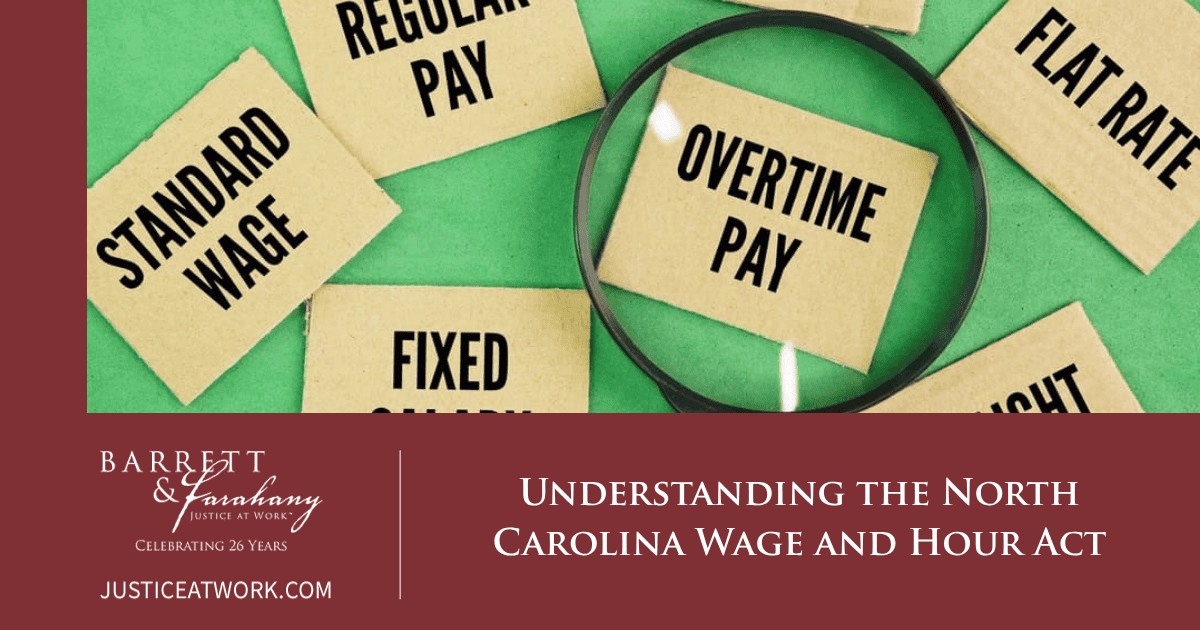
The North Carolina Wage and Hour Act governs minimum wage, overtime pay, wage deductions, promised wages, and youth employment protections for many workers across the state.
Key Provisions of the NCWHA
The North Carolina Wage and Hour Act (NCWHA) establishes clear state-level standards for how employees must be compensated. It applies to most employers in the state, ensuring workers are paid all earned wages on time.
1. Minimum Wage Requirements
North Carolina currently aligns its minimum wage with the federal standard. Employers are required to pay non-exempt employees at least $7.25 per hour. While some states have enacted higher minimum wages, North Carolina employers must strictly adhere to this baseline rate for all covered workers.
2. Overtime Pay Regulations
Working long hours takes a toll, and the law ensures you are compensated for that extra time. Under the act, non-exempt employees must receive overtime pay at a rate of 1.5 times their regular hourly rate for any hours worked over 40 within a single workweek.
3. Wage Payment Rules
Predictability in pay is a fundamental right. Employers are legally obligated to pay wages on designated, regular paydays.
Furthermore, if an employee is separated from the company — whether they quit or are terminated — the employer must pay all outstanding wages due on or before the next regular payday. Withholding a final paycheck as retaliation or leverage is strictly prohibited.
4. Promised Wages and Benefits
North Carolina law does not explicitly require employers to provide paid vacation, sick leave, or holiday pay. However, if an employer establishes a policy or formally promises to provide these benefits, those payments are legally classified as protected “wages” under the Act. Employers cannot arbitrarily revoke these promised benefits once they are earned.
5. Permissible Deductions from Wages
Employers have very limited power to deduct money from your paycheck. Deductions for cash shortages, inventory loss, or damage to company property are only permissible if the employer has obtained prior written authorization from the employee.
Even with authorization, these deductions are subject to strict notice requirements. Employers cannot drop the employee’s pay below the minimum wage for that pay period.
6. Youth Employment Restrictions
To protect young workers, the Act strictly limits the hours and types of work available to employees under the age of 18. There are distinct, heavily regulated rules for 14- and 15-year-old workers compared to 16- and 17-year-old workers, ensuring their employment does not interfere with their education or compromise their physical safety.
Key Exemptions and Differences from Federal Law
While the NCWHA operates alongside the federal Fair Labor Standards Act (FLSA), there are important distinctions and exemptions that North Carolina workers need to understand.
Exempt Employees
Not all employees are entitled to overtime pay. Workers classified as exempt — typically those in executive, administrative, or professional roles — are not eligible for the 1.5x overtime rate.
Determining whether an employee is genuinely exempt depends on their specific job duties and salary, not just their job title. Misclassifying employees as exempt to avoid paying overtime is a common tactic used in wage theft.
Applicability to Small Businesses
Federal law (the FLSA) often uses revenue thresholds to determine if a business must comply with its regulations.
In contrast, the North Carolina Wage and Hour Act generally applies to many businesses regardless of their size or annual revenue. This broader scope ensures that employees working for small, local businesses still receive fundamental wage protections.
Vacation Pay Forfeiture Policies
Because promised vacation pay is considered a wage, employers cannot simply erase it when you leave the company.
Accrued wages, including vacation pay, may not be forfeited upon separation unless the employer explicitly notified the employee in writing of a forfeiture policy before the time those wages were actually earned.
Protect Your Hard-Earned Compensation
The North Carolina Wage and Hour Act provides critical protections to ensure you are paid fully and fairly for your labor. From securing basic minimum wage to protecting promised vacation pay, these laws hold employers to a strict standard of accountability. When employers skirt these rules, it is the workers who carry the burden.
Do not let an employer unlawfully withhold the money you depend on. If you believe you are a victim of NC wage theft, or if you have questions about unpaid overtime and unauthorized pay deductions, it is time to seek professional guidance.
Contact Barrett & Farahany today to speak with experienced employment attorneys who are ready to advocate for your rights and help you recover the compensation you deserve.